Weight Loss: What are the Realities?

HAPPY NEW YEAR!!!

People have been dieting for centuries and the best advice from the so-called experts or fad diet enthusiasts still tell us to – “eat less and move more”.  This in itself is good advice but does not even begin to offer what is needed to keep that weight off and save you from the diet cycle of weight gain, loss, gain, loss cycles. There would not be billions of dollars spent trying to lose body weight over and over again for millions of people.  My own experience with weight loss has been limited fortunately most of my adult life due to not having to diet. But there was a price. More specifically, I was on a continuous reducing diet my whole life to prevent weight gain in the first place.  I remember weighing  94 pounds at a height of 5 ‘ 5 inches tall.  But as a nutrition student, I knew that was not a healthy weight by any account and being in a “starvation” mode for a lifetime is not the way to go.

Eventually as I got older and put on a few unwanted pounds, I finally did “go on my first formal diet” a few years ago. Specifically it was a low carbohydrate diet and it worked slowly but consistently. But it did take a lot of hard work. I have now kept that weight off for the past few years.

But every woman at any weight wants to lose those “last five pounds” and I am one of them. But did I ever learn a lot how our bodies fight against weight loss in order to prevent what it perceives as starvation. So now I know what hard work it is. So many diet programs try to make it seem easy and all it does for a lot of people is to make them feel guilty for not succeeding after each attempt. So here are some truths.

Some basics:

Only about 1/3 of dieters are successful at maintaining their loss. Chronic dieters know it takes vigilance and for some weight maintenance is harder to accomplish than the actual loss.

Weight maintenance requires continued modification of your lifestyle – you cannot let yourself go back into the old habits that caused the weight gain in  the first place.

Some people relax their vigilance too much after they lose the weight, then gain it right back. You can relax a little, but not too much.

You will be tempted by certain foods and certain situations – moderation is the best approach to keep in mind in those difficult situations. Diets are not just about the kinds of foods we eat, but how we eat.

Successful Losers/Maintainers (From The National Weight Control Registry (NWCR) of people who have lost at least 60 pounds and kept it off for a minimum of five years). This is what they have found to be successful from their weight loss and weight loss maintenance.

  • Write your food intake down. Keep a journal or visit MyFitnessPal to help you track your typical food intake. This is a must – it is so easy to forget what you ate yesterday or how many snacks you mindlessly consumed.
  • Most losers follow low fat diets and more recently I would suspect low refined carbohydrates,  no gimmicks, special diet foods, or magic pills. Most simply do not work.
  • Exercise daily – walking is most popular and it should be scheduled into your day like brushing your teeth. About an hour a day is practiced by NWCR members.
  • Eat breakfast – all the research supports this, so intermittent fasting was not much of a factor.
  • Weigh in regularly. This advice goes against many experts who say “stay away from the scale”. However, in my opinion, this tool is necessary to see if you are gaining a few pounds, you can then make some adjustments to your diet to get back to your intended goal weight. You be the judge on scale use – if it helps you stay on track, use it.

The bottom line: The longer you keep the weight off, the easier it becomes to maintain the loss. It becomes more of a part of your lifestyle and not just considered a “diet”.  If you can make it for two years, you’re more than likely to become successful. The practice of intuitive eating (mindful) can help dieters keep their weight off – it  teaches you to think of food in an entirely different way. Why repeat the old habits that caused you to gain weight in the first place. Future posts will address intuitive eating more thoroughly. It’s worth it to know especially for maintaining your lost weight.

For now, the basic principles can be  thought of as:

MODIFICATION

 MODERATION

MINDFULNESS

MANAGEMENT
CLICK HERE.

Eat Like the French?

Eat Like the French?

To safeguard one’s health at the cost of too strict a diet is a tiresome illness indeed.

Francois Duc de La Rochefoucauld (1613-1680)

French writer and moralist

To say the French know their food is an understatement. Even their children are aware of the gourmand cuisine – they have two-hour multi course lunches in schools and the presentation and preparation of the food becomes a normal part of their education.

A lot of attention was paid to the French way of eating due to what became known as the “French Paradox”.  Consider these facts:

The French diet is high in saturated fat compared to the American diet. The good cholesterol (HDL) and high blood pressure rates are about the same as they are in North America; however, the total serum cholesterol levels are higher in the French population. Their smoking rates are relatively high which is a risk factor for heart disease.

So, all things considered, the French should have a lot more heart attacks than the U.S. population with our obsession with cholesterol and smoking cessation efforts. But quite the opposite is true. Compared with North Americans, the French are far less likely to die of heart disease with reports of death rates that are among the lowest in the world – second only to Japan. Also their rates of colon and prostate cancers are roughly 30 and 60 percent lower, respectively, than those in the U.S.  That’s the paradox!!

Another part of the puzzle is that the French are leaner.  In 2010, their obesity rate was 17% whereas in America in 2015 it is close to 39.8% and counting. The French are reported to live longer on average – French men by about a year and French women by two and one-half years. Is it genetics? Probably not much  – when the French move to Montreal and begin to consume a more Western diet, they get “fatter” and their heart disease rates begin to resemble that of North America.

The Traditional French Diet At A Glance: Surprisingly Simple in Form with no tricks or gimmicks

  • Moderate drinking – one to two drink a day defined.
  • Lots of fruits and vegetables (35 to 38 percent of total calories) or on average four or more servings of vegetables a day.
  • No snacking or dieting – this is astounding! Compare to the typical American with our vast snack aisles in the supermarket and our obsession with diets (fad and otherwise).

Source:  30 Secrets of the World’s Healthiest Cuisines, Steven Jonas, MD and Sandra Gordon

How do they stay so slender?

Their food is nutrient dense. They emphasize quality over quantity.

Eating is mindful at each meal. They pay close attention to the type of foods they eat.

They don’t eat in a hurry or when stressed or in front of the TV.

They see food as a ritual with accompanying wine, family or friends, laughter and reverence of the food quality.

 They enjoy market trips and understand where their food comes from. They favor seasonal, local foods.

“Sinfully delicious” is a ridiculous oxymoron in French culture. They eat without guilt.

They adhere to traditional dietary guidelines and eat a wide variety of foods. The children eat what is given them. Most French parents would never give their children the option of a hot dog instead of eating “grownup foods.”

The French don’t count pounds or calories or step on the scale each morning. Instead they are mindful of how their clothes fit – using the “zipper syndrome” or a tape measure. When clothes feel tight – they will simply cut back on high caloric dense foods or have a lighter dinner.

They are aware that yo-yo and crash dieting ruins their metabolism since the body senses a period of starvation and then burns calories more slowly to conserve energy.

They don’t eat “fake” foods – they stick to butter instead of using canola oil sprays, e.g.

They appreciate the art of cooking (remember Julia Child?)

We think we know a lot about nutrition science, but we may sadly be kidding ourselves. We can learn a lot from other cultures and their traditional ways as exemplified by the French experience and the following known the Roseto Effect.

“A remarkable discovery by physician Stewart Wolf found a strikingly low incidence of heart disease and deaths from heart attacks, spanning three generations, in a small Italian immigrant community in Roseto, Pennsylvania and was reported in the early 1990s.

It was a astonishing discovery that it wasn’t their diet that was protecting their heart health. To the contrary, Rosetons embraced westernized foods and cooking, at the expense of their Italian-Mediterranean culinary roots. For example, they:

  • Shunned olive oil, and used lard instead, as the main fat for cooking.
  • Dipped their bread in a lard-based gravy, rather than olive oil.
  • Ate an Italian ham, including its one-inch rim of fat.
  • The average Roseton diet was high in fat, containing 41% of calories from fat.

The distinguishing protector of their heart health and longevity was found to be social cohesion and social support.

—once again as with the French, effect of positive emotional experiences can have a greater impact on health than which foods people actually eat.”

Source: Evelyn Tribole, M.S., R.D. and Elyse Resch, M.S., R.D., F.A.D.A., C.E.D.R.D. Intuitive Eating: A Revolutionary Program That Works. Page 201.

My opinion: We find this same phenomenon in the study of the Blue Zones cultures where lifestyle patterns appear to affect the longevity and health of these populations. We need to rethink how we diet and learn to maintain our weight losses.  From my experiences, it may be prudent to begin to seriously investigate the role that mindfulness and intuitive eating has on our food intake and body weight maintenance.

How Did We Get From There to Here?


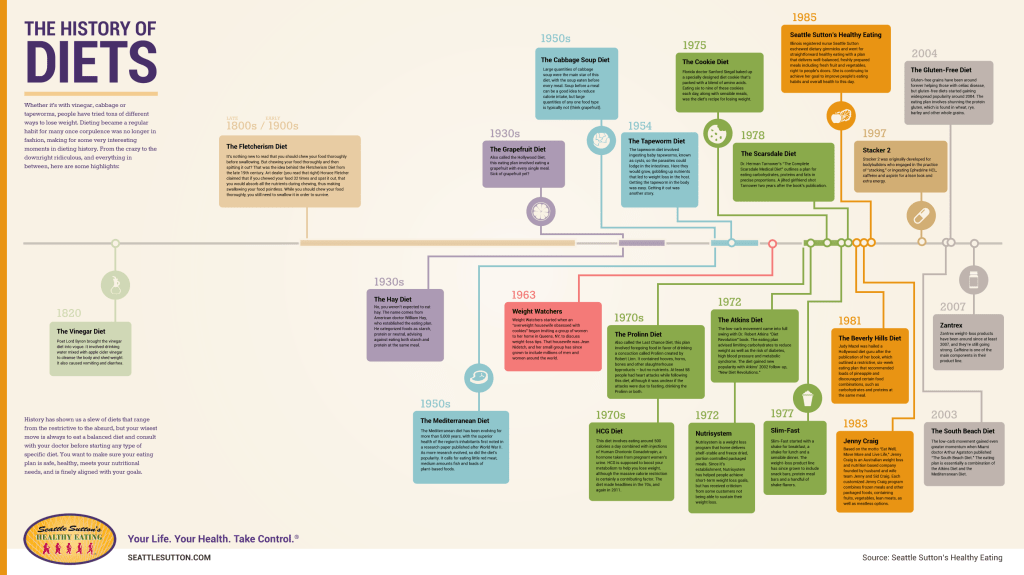
A DIET HISTORY TIMELINE

1825 A French lawyer named Brillant-Savarin said in a publication entitled The Physiology of Taste: “More or less rigid abstinence from everything that is starchy or floury” is a cure for obesity.

1830 Sugar consumption, mainly as molasses) had increased in the U.S. to 15 pounds per capita.

1863 William Banting lost 65 pounds on a high fat, carbohydrate restricted diet and subsequently published, Letter on Corpulence, Addressed to the Public. He based his success on the advice of his physician, Dr. William Harvey.

1900 Lillian Russell, a stage actress and singer born in 1861. was repeatedly mentioned known as one of the most beautiful women on the American stage.” At the peak of her fame, Russel weighed approximately 200 pounds and was celebrated for her curvaceous figure. She was described ” a particularly robust and healthy creature, who takes good care to remain so.” By today’s standards, her weight would be classified as “obese”.

1911 Proctor and Gamble introduced Crisco – a highly hydrogenated vegetable fat and cheap alternative to lard – the primary cooking fat at the time. The advantage to the manufacturer and the cook was a longer shelf life but provided a multitude of hundreds of pounds of unhealthy trans fatty acids. Now trans fats are banned.

1913 The twenty-seventh President of the United States, William Howard Taft reportedly was stuck in the White House bathtub due to his massive girth.

1918 Lulu Hunt Peters, an American doctor wrote the first known diet book, Diet and Health with a Key to the Calories. It was a best seller with over 2 million copies sold. She was the first to mention that cutting calories was an effective weight-watching tool. Her success was more than likely prompted by the new body image of women as being slender, or “thin was in”.

1920 Sugar consumption reaches 100 pounds per capita in the U.S.1930 Margarine consumption reaches 2.6 pounds per capita.

1934 A blood test for cholesterol was developed.

1937 – The Debate Begins (aka What’s going on here?) Columbia University biochemists David Rittenberg & Rudolph Schoenheimer demonstrated that dietary cholesterol had little or no influence on blood cholesterol. This scientific fact has never been refuted.

“Cholesterol in food has no affect on cholesterol in blood and we’ve known that all along.”  These are the words of Professor Ancel Keys, American Heart Association board member and author of The Seven Countries Study who, in retirement, recanted the idea that dietary cholesterol raises blood levels. His recant has been greeted with silence. Keys studied 22 countries, but chose data from only seven.  He also excluded France with high fat and low rates of heart disease. Due to this, his observational study was considered to be flawed.

1950 – 1955 Dietary emphasis on fats and cholesterol in the diet became a hot topic based on  Ancel Key’s flawed study.

1955 – President  Dwight Eisenhower had a heart attack.  His twice-daily press conferences focused on his cholesterol levels and he was put on a low fat diet by his physician, Dr. Paul Dudley White.  Dietary fat also became the villain for weight gain.

1957 Margarine outsold butter for the first time – more trans fat and an increase in omega-6 fats shown to be inflammatory to the body tissues.

1961 Let the Diet Books Begin. Calories Don’t Count was published by Dr. Herman Taller.  The low-calorie diet is a humbug, he declared. He was also a dieter whose weight ballooned up to 265 lb. on a 5-ft. 10-in. frame. Taller recommended a high-fat diet supplemented by polyunsaturated safflower oil capsules high in omega-6 linoleic acid.  Back in the 1960’s vegetable fats were new and everyone wanted them to be a new health food.  This has not been supported in the last 50 years of research. The American Heart Association adopted the well-known low-fat diet that began an era of fat maligning and the glorification of low fat foods.  Dieters began to count fat grams daily.  However, during our national experiment with a low-fat diet, people continued to pile on the pounds every decade.

1978 High fructose corn syrup enters the sweetener market. By 1985, 50 percent of the this sweetener was consumed in America.

1980 -1990 Obesity levels had remained between 12-14 percent from 1960 to 1980. After 1980 and then again in 1990, obesity grew dramatically until today when every state has obesity rates over 25 percent.  Type 2 diabetes is now reported to have a 1 in 3 lifetime risk.

1992 The Food Guide Pyramid was introduced, recommending 6-11 servings of breads, cereals, rice, or pasta a day without mentioning whole grain options.

2000 Soybean oil has 70 percent of the edible fat market in the U.S.  Lard consumption is less than 1 pound.  Sugar cons0umption in the U.S. 150 pounds per capita. Butter consumption is less than 4 pounds per capita

2004 After 50 years of Egg-beaters, low fat cheese, margarine, skinless chicken breasts, and highly processed soy and canola oils, two Food Guide Pyramids and 11 releases of the USDA Dietary Guidelines,  one third of Americans are obese; 25 percent are diabetic or pre-diabetic.

2008 Sugar consumption is now 160 pounds per capita. Compare that to the 15 pounds per capita in 1830.

2011 No More Pyramids A simplified MyPlate is introduced as the latest attempt at Food Guides. My Plate recommended 30% of the plate as grains, 30% vegetables, 20% fruit and 20% protein. A small circle represents dairy.

2015-16   The 2015 Dietary Guidelines were presented with little changes based on the latest research. Here is what they said and what they should have said.This is a big change  For the first time, our national health authorities are urging Americans to limit sugar to no more than 10% of daily calories. In a 2,000-calorie diet, 10% is 200 calories—the equivalent of about 12½ teaspoons of sugar. Yet we average 20 teaspoons a day. Based on scientific evidence that’s been accumulating for decades, dietary cholesterol (as opposed to blood cholesterol) just isn’t any concern anymore. For the first time, there is no limit on total fat. However, the advice to limit saturated fat is still in there—even though the evidence that saturated fat leads to heart disease has turned out to be pretty weak. An original report associated with the new guidelines called for cutting back on red meat, especially processed meat, but the final official guidelines due to the lobbying of the meat industry wanted its message weakened.

2010-2020 The American Journal of Clinical Nutrition published a landmark report that has turned current fat recommendations upside down. The verdict from the study is that “there is no significant evidence for concluding that dietary saturated fat is associated with an increased risk for heart disease. ’Over the same period, the use of drugs to treat high blood pressure and high cholesterol increased quite a bit. Meat consumption has been declining for the past few decades..

In the last decade the prevalence of Type 2 diabetes has increased by almost a percentage point. Over the same period, obesity has increased by three percentage points. If that trend continues, heart disease rates may again rise. Unless we have been infected by a yet to be discovered obesity virus, we have a national eating disorder that needs to be fixed.

MY OPINION

Big food has made quite a mess of our food supply. Is saturated fat the culprit it was made out to be?  Can excess refined vegetable oils, sugar or fructose be  blamed?

Will our food culture ever be able to return to a diet of whole, real foods to replace the refined, processed, chemical-laden foods forced upon us by the food industry? The debate continues and we will see what trends are coming with the advent of the new Dietary Guidelines due in 2020. We should also hope that these guidelines are not encumbered by the influences of the food industry – but don’t count on it.


The Mediterranean Diet? Olive Oil and Longevity

The Mediterranean Diet has gained fame and much has been written about it since its debut circa 1960. Actually, there is no one Mediterranean diet, the diets of southern France, Italy, Spain, and Greece share several characteristics that make this healthy diet what it is today.

What makes this diet so important for our health? Disease statistics and incidence rates show that countries eating the Mediterranean way for centuries have traditionally been on the good side. These countries have reported statistics that have significantly lower death rates from cardiovascular disease than does the United States. Each of these countries also shows only a fraction of the U.S. rates for breast, prostate, lung and colon cancers. Furthermore, on average, the people of the Mediterranean live about a year longer than U.S. citizens.

What is this diet all about?

CLICK HERE.

Blue Zones in America?

Dan Buettner, author of The Blue Zones and The Blue Zones Solution has revealed that the world’s longest living people have lived lifestyles over the past 100 years that help them and others lead healthier and more fulfilling lives.

One of these lifestyles includes their diets.  Buettner’s teams have helped thousands of people lose weight and reverse disease by changing the way they live, eat, and connect with each other. Ultimately, these changes can transform your health and help you live longer.

The basis of this diet at a glance:

  • Rich in “healthy” fats including olive oil and omega-3 fatty acids.
  • Vegetables abound; meat is minor.
  • Loads of beneficial herbs.
  • Moderate drinking.
  • Practice of a slower pace of life with a strong social connection.

FYI: There is a new book by Dan Buettner called The Blue Zones Kitchen: 100 recipes to live to 100. The information is priceless and the photographs are stunning (provided by David McLain and National Geographic).

CLICK HERE.

Vegans: Nutrients Needed Beyond B12 and Vitamin D

The debate will continue as to whether vegan diets can furnish all  the nutrients we need. The following article discusses seven of them not abundantly found in plants and in some cases not found at all or not well-absorbed. Vegan diets and/or vegetarian diets can be healthy,  but if you are considering veganism in any form, please become fully informed on some of the lesser known issues that need to be addressed.

CLICK HERE.


The 2020 Dietary Guidelines: A Sneak Peak?

“Good” Carbohydrates

Every five years the Dietary Guidelines for Americans are reassessed with the hope that the information for the consumer is based on the latest scientific evidence.Sometime In 2020 we shall see the results of the  current Dietary Guideline’s Committee conclusions (we hope the conclusions are based on sound science and free of the influence of the food industry.)

A disturbing possibility is that we may not find this happening – more than half of the DG Committee is reported to compose of members from the food industry. Also, the list of issues has been restricted as to what types of foods can be Included. If this is true, we may have to ignore the new Guidelines and rely more on the recommendations from the past (i.e. the 2015 Guidelines that may be less corrupted by bias.)

We shall see. Stay tuned. Let’s give them a chance before we criticize or praise them too much. In my opinion, we need to have guidelines we can trust to be the latest ones we know or think we know based on good science – it looks like global obesity is on the rise.

CLICK HERE.

Vegetarians: It’s Not Just Vitamin B12

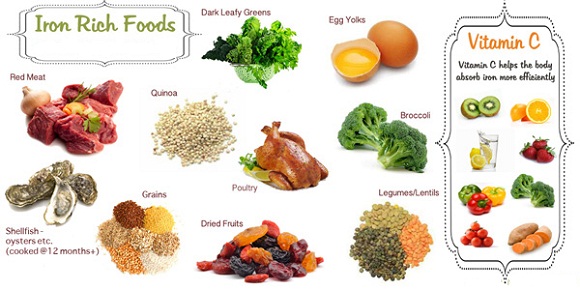
We so often warn vegetarians that they need to find a reliable source of vitamin B12. However, iron is a nutrient that is assumed to be adequate in the vegan diet, but due to its bioavailability issues, it is often not enough to prevent an iron deficiency, especially in women and children. Iron deficiency is a disorder that results from a depletion of iron stores in the body. It is characterized by weakness, fatigue, short attention span, poor appetite, increased susceptibility to infection, and irritability.

How does  iron function in the body?

  1. Oxygen enters the lungs.
  2. Oxygen attaches to iron in hemoglobin and myoglobin (found in red blood cells and muscle cells.
  3. Oxygenated hemoglobin transported in blood to body cells, drops off oxygen.
  4. Iron in hemoglobin then picks up carbon dioxide from cells and transports it to the lungs.
  5. Carbon dioxide is released from iron in hemoglobin
  6. Carbon dioxide is exhaled from the lungs.

This function of iron operates smoothly when the body’s supply of iron is sufficient. Unfortunately, that is often not the case. For example, a 3-ounce hamburger and a cup of asparagus both contain approximately 3 milligrams of iron, but 20 times more iron can be absorbed from the hamburger than from  the asparagus. See the following article for why  this occurs and what to do about it. Souce: Judith E. Brown, Nutrition Now, 7th edition

CLICK HERE.


The SAD diet: A global approach

When discussing the Standard American Diet, diet advice keep emphasizing what not to eat and ignores the more important aspects of a healthy diet, in other words, what to eat. This article addresses a more detail about how the SAD may be killing us, not only in our country but how it affects other countries when their populations adopt more Western ways of eating and often stray from their traditional diets.

CLICK HERE.

Calling Dr. Kellogg

When in the supermarket, have you noticed lately the extent of the cereal aisle?  How many choices do we need? A lot of people start the day with their favorite. For example, an all-time favorite of Frosted Flakes states on the box – “Sweetened Flakes of Corn Cereal.” but also contains wheat starch. But what else do we find?

First we see that primarily, 1/1/4 cup serving provides us with:

  • No fat or cholesterol (that’s fine)
  • Total Carbohydrate: 37 g. (eh)
  • Of that there are 0 grams of fiber and 15 grams of added  Sugars (not so good)
  • They also throw in a few milligrams of iron,  70% percent thiamine, and 10% each of niacin, vitamin B6, folate, pantothenic acid  and zinc – that’s about it.

They do provide some entertainment on the box with a fun game of FIND A PENGUIN FRIEND (sort of a take off of Where’s Waldo.) if you get bored eating the cereal.

How did all this begin? In other words, how did we get here?

CALLING DR. KELLOGG

By Sally J. Feltner, M.S, PhD.

John Harvey Kellogg was born in 1852 in Tyrone, Michigan and died at the age of 91 in Battle Creek, Michigan He was a medical doctor and graduated from New York University Medical College at Bellevue Hospital in 1875. He married Ella Ervilla Eaton in 1879 and had no biological children except for 42 foster children, legally adopting eight of them before Ella died in 1920. He had one brother, Will Keith Kellogg.

After medical school, he became the chief physician in 1866 at the Western Heath Reform Institute of Battle Creek, founded by the Seventh Day Adventist leader, Ellen G. White. This soon became the Battle Creek Sanitarium, aka “the San” and its health principles were based on the Church including vegetarianism. Through the years, the San had many notable patients/guests that included former President, William Howard Taft, arctic explorers Stefansson and Amundsen, writer and broadcaster, Lowell Thomas, aviator Amelia Earhart, playwright George Bernard Shaw, athlete Johnny Weissmuller, Henry Ford, Thomas Edison and actress Sarah Bernhardt.

Dr. Kellogg believed that almost all disease began in the stomach and bowels and promoted daily yogurt enemas to clean the intestines. He also encouraged his guests to practice breathing exercises and mealtime marches to promote proper digestion during the day. He strongly believed in nuts which he thought would save mankind in the face of decreasing food supplies and developed a patent for making peanut butter. He also thought that coffee was unhealthy for the liver and that indigestion was the leading cause of death. Most spices were unhealthy and vinegar was a “poison, not a food.”

While a medical student in New York in 1874-75, Kellogg began to be aware of the need for ready-cooked foods, at least ready-to-eat cereals. As part of the “Sans” menu, Kellogg and brother Will made several grain products by forcing wheat grain through rollers to make sheets of dough. One time, the dough seemed overcooked and the dough when flattened emerged as a flake. After this, the sanitarium became famous for its wheat and corn flakes. Many guests had complained that the hard biscuits they served had played havoc with their teeth, so the invention of the flake alleviated this issue.

Kellogg believed that most disease is alleviated by a change in intestinal flora; that bacteria in the intestines can either help or hinder the body; that pathogenic bacteria produce toxins during the digestion of protein that poison the blood; that a poor diet favors harmful bacteria that can infect other tissues of the body; that the intestinal flora is changed by diet and is generally changed for the better by a well-balanced vegetarian diet favoring low-protein and high fiber foods. Ironically, the theory that intestinal bacteria influence some disease states is gaining favor recently – maybe Kellogg was correct to a point.

By 1905, the Kellogg brothers were selling their corn flakes under the name of the Sanitas Company and had competition from a number of other companies in Battle Creek. One of his former patients, C. W. Post had started his own cereal company and Kellogg accused Post of stealing his corn flake formula. Will Kellogg wanted to add sugar to their cereals, but Dr. Kellogg disagreed with him. C.W. Post added sugar to his cereal however. Will left the Sanitarium and started the Battle Creek Toasted Corn Flake Company in 1906. The brothers had a strained relationship over business dealings in which Will sued his older brother. The case lasted for most of the rest of their lives with Will eventually winning the suit.

John Harvey continued to run the San but due to the Depression, it was sold. He did establish another health institute in Florida.

So this is a brief history of the vast ready-to-eat cereal industry we presently enjoy. Lately there has been a recommendation to lower our sugar intake and cereals are often named as “culprits.” Even though Dr. Kellogg was often thought of as eccentric in his beliefs, his thoughts on adding sugar to his corn flakes may have been prudent and Tony the Tiger would not be in so much trouble today with its added sugar content.

I wonder what John Harvey would think now.