Researchers analyzed data from nearly 1500 women, ages from 64 to 95. Results reported that elderly women with less than 40 minutes of moderate-to-vigorous physical activity per day, and who remain sedentary for more than 10 hours a day, have shorter telomeres – tiny caps on the ends of chromosomes of DNA strands.
Telomeres protect chromosomes from deterioration and progressively shorten with age. As a cell ages, its telomeres naturally shorter and fray, but unhealthy lifestyles such as obesity and smoking may accelerate this process. Shortened telomeres are associated with heart disease, diabetes and major cancers. This study was funded, in part, by the National Institute on Aging and conducted at the University of California San Diego School of Medicine.
Tea May Protect Against Coronary Artery Disease
A review of randomized trials published in the journal Clinical Nutrition ESPEN, concluded that regular intake of green tea may help reduce the risk of cardiovascular disease.
Regular tea consumption was associated with lower blood pressure and enhanced bioavailability of nitric oxide, which indicate a beneficial effect for tea on endothelial function. In some studies, tea was associated lower markers of oxidative stress and inflammation (C-reactive protein and oxidized low -density lipoprotein (LDL).
NOTE: ENDOTHELIAL= the tissue which forms a single layer of cells lining various organs and cavities of the body, especially the blood vessels, heart, and lymphatic vessels.
Clin Nutr ESPEN. 2021 Feb;41:77-87.
More Good News for Garlic Lover
Garlic supplementation Improves metabolic syndrome. Phytother Res. 2021, May 11.
I am not a promoter of supplements except in situations when you don’t want to smell like a raw garlic bulb every day.
Editors Note: Metabolic syndrome is becoming a marker for good health especially in the older population; however its presence can occur even in younger people. It is diagnosed as having three of the following disorders: high triglycerides, high blood pressure, elevated blood sugar and low levels of HDL cholesterol. These disorders collectively are thought to contribute to a higher risk of developing diabetes and/or heart disease
A randomized clinical trial included 90 men and women with metabolic syndrome were supplemented with tablets containing 1600 mg of garlic powder daily for three months, or a placebo.
In the garlic group, results were as follows:
All parameters were reduced along with appetite, fatty liver index,and waist circumference. Additionally, beneficial HDL cholesterol was significantly higher than at the beginning of the study compared to the placebo group.
“Then, there is cancer. Compounds in garlic have been shown in many laboratory studies to be chemoprotecive. Epidemiological studies shows a decreased risk in stomach and colon cancer in areas where consumption of garlic is high. An article In the Journal of Nutrition stated that “evidence continues to point to the anticancer properties of fresh garlic extracts, aged garlic, garlic oil.”
Source: Jonny Bowden, Ph.D., CNS. The 150 Healthiest Foods on Earth. 2007.
“Poor diets lead to a host of medical issues: obesity, cardiovascular disease, diabetes, and certain cancers. But diet also influences the brain and can increase the risk for mental disorders and neurodegenerative diseases. Researchers are uncovering the details of how the foods we consume affect our cravings, our moods, and even our memories.”
We hear so much these days about omega 3-rich fish oils as well as omega-6 rich oils. Today we consume ten to 20 times more omega-6 fats and have dramatically reduced our intake of omega-3 fats. This goes against our hunter-gatherer evolutionary history of a 1:1 ratio. Recent research indicates that people who regularly consumed omega-3-rich oils such as flax seed, olive and walnut oils were 60 percent less likely to develop dementia than those who did not regularly consume such oils. Y. Zhang, et al. “Intakes of Fish and Polyunsaturated Fatty Acids and Milk-to-Severe Cognitive Impairment Risks…. American Journal of Clinical Nutrition 71, no.2 (2016):330-40.
A lot of recent attention has been paid to the role of lifestyle in many chronic diseases (lately referred to as underlying causes of mortality in the Covid-19 viral pandemic). Deaths due to this virus have been strongly associated with age, obesity, high blood pressure and diabetes to name a few. Many people with the viral infection have reported to have had at least one or two of these chronic conditions. Obesity alone has been known to be associated with low-grade inflammation.
Recently, we have changed our ideas about diet and heart disease. Many doctors still think the high fat, high cholesterol diet of the last decade was to blame. However, this is a simplified view that dismisses the research that now supports the possibility that heart disease is mediated by other biological events other than cholesterol, including oxidative stress (free radicals), insulin sensitivity, endothelial dysfunction and blood clotting mechanisms and most importantly low-grade inflammation.
(FYI – endothelium is the tissue which forms a single layer of cells lining various organs and cavities of the body, especially the blood vessels, heart, and lymphatic vessels.)
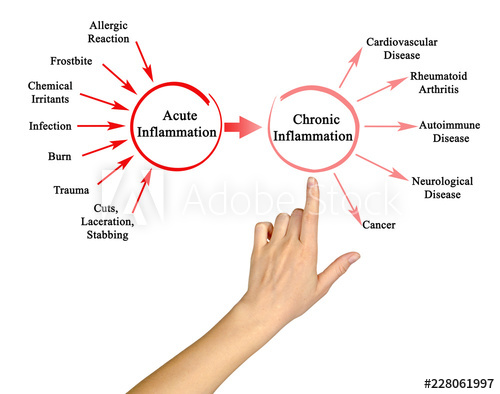
We should be aware that inflammation is a double-edged sword. Inflammation in the body is necessary to protect us from infections and cancer and when appropriate from diseases. In its acute state as when you cut your finger, its reactions are self-limiting and resolve rapidly; the process is meant to heal and repair tissue damage. However, when inflammation is inappropriate it can get out of hand and contribute to disease especially chronic diseases. That is when inflammation can become your enemy. We call this low-grade inflammation. In this type, the inflammatory response needs be controlled or managed or at least short lived. Should it continue, persisting cytokines of the immune system can produce excessive damage, leading to a number of diseases.
(FYI – cytokines are small protein chemical messengers used by immune defensive cells that affect other cells and the immune response to an infectious agent.
It is thought that accumulating degrees of oxidative stress, and low-grade inflammation can result in what is now commonly called the “cytokine storm.” Septic shock can result from a cytokine abundance, leading to death.
Recently, it is thought that positive dietary choices you can make can help to reduce low grade inflammation and prevent this process. Your inflammatory biomarker status can be measured by a simple blood test. The most used is one called high sensitivity C-Reactive protein (hsCRP).
The goal of this blog post is to guide us to the right anti-inflammatory foods to reduce our risk of illness. Consistently, pick the wrong ones, and you could accelerate the inflammatory disease process.
Foods that allegedly promote inflammation – try to limit these foods as much as possible:
Refined carbohydrates such as white bread and pastries; choose whole grains instead.
French fries and other fried foods
Soda and other sugar-sweetened beverages
Red meat (burgers, steaks) and processed meat (hog dogs, sausage)
Margarine, shortening, lard (high levels of trans fatty acids)
Foods that allegedly reduce inflammation – include in the diet as much as possible
Tomatoes rich in lycopene and carotenoids – healthy phytochemicals
Olive oil – rich in monounsaturated fat and phytochemicals
Green leafy vegetables such as spinach, kale, collard and other greens – a randomized German study showed that 8 servings of fruits and vegetables for 4 weeks in men had lower levels of hsCRP.
Nuts like almonds and walnuts – high in monounsaturated fats
Fatty fish like salmon, mackerel, tuna, sardines – Diets rich in omega-3 fatty acids reduced inflammation.
Fruits such as strawberries, blueberries, cherries, and oranges
Fiber consumption was associated with less inflammation in seven studies, using hsCRP as a biomarker.
Bottom Line:
No one food can be the “magic bullet” for good health. A Mediterranean diet is a good example of a diet that reduces low-grade inflammation and at the same time appears to reduce the risk of heart disease. It is a diet pattern that has been studied extensively and without a doubt scores high in the healthy column.
“Nearly 50% of food influencers are actively seeking more plant-based options. Major retailers are asking their suppliers for more plant-based products for their shelves and restaurants that have added vegan options to menus have seen an increase in business while the competition has struggled. These are all signs that point to plant-based being more than just a trend. It is a blossoming cultural movement and we are still in the earliest stages!”
The Blue Zone diet is based on populations in the world that live the longest. The study was pioneered by Dan Buettner, a National Geographic best-selling author. After many years of interviews with centenarians, he and his team discovered five zones of the world that exhibited the most longevity: Okinawa, Japan, Sardina, Italy, Ikaria, Greece, Loma Linda, California and Nicoya, Costa Rico. They called these areas “Blue Zones” and here is just one of their stories:
A real-life experiment -that speaks for itself. There is a great need for studies that attempt to measure the actual effects of the Standard American Diet (SAD) on the body. This study is not a clinical trial, and the results are somewhat subjective. It was only one subject but maybe more effective to everyone than obtaining food records from study participants relying on memory. The best way would be to measure metabolic parameters like LDL or HDL cholesterol, liver enzymes, hormones, blood pressure, e.g. This study did rely on brain scans and some lab work.
Many studies are often funded by the industry and the results are only for Big Food promotion of their own products. “Without understanding who paid for the research, it’s hard for anyone to know what dietary advice to follow.” Source: Marion Nestle, Unsavory Truth: How Food Companies Skew the Science of What We Eat, 2018.
Neverthless, I find the above study interesting and worth a read. (my opinion, SJF)
Food: there is plenty around and we all love to eat. But unfortunately, a lot of it we are consuming today is really not food. We eat it in the car after purchasing it at our favorite fast food establishment, or in front of the TV and often alone. We grab a bag of some kind of “healthy -sounding” food on the package and we call it lunch and sometimes even dinner.
Michael Pollan wrote a book a few years ago (2008) called In Defense of Food: An Eater’s Manifesto. I highly recommend that every American who eats read this book. He refers to our current food choices as “not real” and describes them as “edible food like substances”. Many come with false health claims promising the same benefits as their “real” counterparts, but as Pollan says: “30 years of nutrition advice has only made us sicker and fatter. In the so-called American or Western diet, these foods are nowhere near being nutritious with their long lists of ingredients that are impossible to pronounce.
“Pollan’s manifesto shows us “how we can relearn which foods are healthy and to develop simple ways to return eating to its proper context -out of the car and back to the table.”
A portion of Pollan’s book In Defense of Food, first appeared in the New York Times Magazine under the title, “Unhappy Meals” and can be found online. The article requires a subscription but does allow a limited number of free articles.
If you want a book full of “straight talk” about our food culture, the book is a must read. The book should be available at reduced used book prices. Check Amazon.
To safeguard one’s health at the cost of too strict a diet is a tiresome illness indeed.
Francois Duc de La Rochefoucauld (1613 – 1680’s) French writer and moralist
“In a study of four countries, food psychologist Paul Rozin at the University of Pennsylvania found the following:
The French are the most food-pleasure oriented and the least health-oriented. In contrast, Americans had the worst of both worlds: They had the greatest worry over their health and had greater dissatisfaction with what they ate. Americans scored the highest on worrying about the fattening effects of food.
Interestingly, Rozin concluded that the negative impact of worry and stress over healthy eating may have a more profound effect on health than the actual food consumed. Indeed, it is widely accepted that stress triggers a biological chemical assault in our bodies, which is harmful to our health.”
“More information about the French reveals that the US currently has twice the incidence of overweight people compared to France for both adults and children. The French have a longer life expectancy, take less medication, and have a markedly lower rate of heart disease. Yet the French eat a diet that appears to be less healthy this is popularly known as the French paradox. Notably, France has the highest per capita dairy fat consumption up of any industrial nation (think cream, butter and cheese.)
Just as important, the French have fewer eating disorders and don’t engage in dieting as much as Americans. It has been speculated that wine consumption and eating smaller portions of food may explain the French paradox, we believe it could be the relationship that the French have with food the French have a more positive attitude toward eating dash it is viewed as one of life’s pleasures not his poison. Food is something to be revered.
Even when the French eat fast food, they take more time to eat compared to the eating pace of Americans.
“According to the calorie control council, 43% of dieters in the United states say that they that snacking too much is the reason they haven’t sustained their desired weight. Unlike north Americans who typically consume as many as three snacks a day, the French don’t usually partake in this between meal ritual this non habit may contribute to the comparatively higher proportion of slimmer figures found in France.
“French children may have an after-school snack which can be a croissant with a hidden dollop of dark chocolate to tide them over until dinner, but regular snacking just isn’t part of the adult French culture. Their substantial lunch often usurps the need for an afternoon snack. Snacks are a novelty in France where in America snacks appear to be a necessity.”
Sources: Steven Jonas, M.D., Sandra Gordon. 30 Secrets of the World’s Healthiest Cuisines, 2000.
Intuitive Eating: A Revolutionary Program That Works, 2012.
NOTE: Although this data may seem a bit dated, the numbers reflect how the French ate a few decades ago. Unfortunately, many of the younger French population has been influenced by a more current French Diet that has incorporated many characteristics of the Standard American Diet leading to a loss of some of original health benefits. For example:
Obesity rates in France are among the lowest in the OECD , but have been increasing steadily. About 1 in 10 people is obese in France, and almost 40% are overweight (including obese). OECD projections indicate that overweight rates will increase by a further 10% within ten years.
Summary: A healthy-plant-based diet was linked to a lower risk of getting COVID-19, and among people with COVID-19 , a lower risk of experiencing severe symptoms.
“….our study suggests that individuals can also potentially reduce their risk of getting COVID-19 or having poor outcomes by paying attention to their diet” says co-senior author Andrew Chan, MD, MPH, a gastroenterologist and chief of the Clinical and Translational Epidemiology Unit at Massachusetts General Hospital.



 FOOD, FACTS and FADS