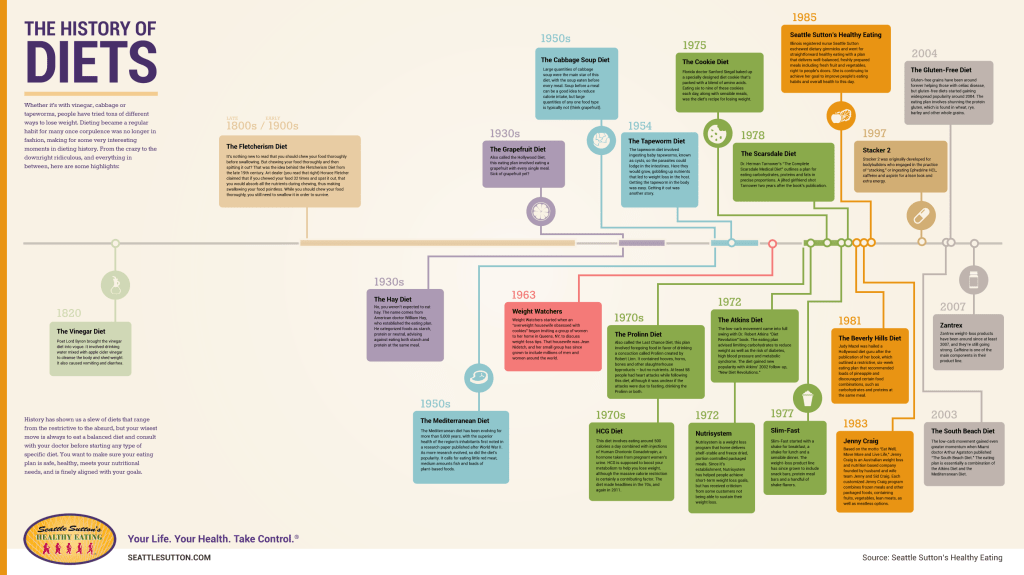
How Did We Get From There to Here?


A DIET HISTORY TIMELINE

1825 A French lawyer named Brillant-Savarin said in a publication entitled The Physiology of Taste: “More or less rigid abstinence from everything that is starchy or floury” is a cure for obesity.

1830 Sugar consumption, mainly as molasses) had increased in the U.S. to 15 pounds per capita.

1863 William Banting lost 65 pounds on a high fat, carbohydrate restricted diet and subsequently published, Letter on Corpulence, Addressed to the Public. He based his success on the advice of his physician, Dr. William Harvey.

1900 Lillian Russell, a stage actress and singer born in 1861. was repeatedly mentioned known as one of the most beautiful women on the American stage.” At the peak of her fame, Russel weighed approximately 200 pounds and was celebrated for her curvaceous figure. She was described ” a particularly robust and healthy creature, who takes good care to remain so.” By today’s standards, her weight would be classified as “obese”.

1911 Proctor and Gamble introduced Crisco – a highly hydrogenated vegetable fat and cheap alternative to lard – the primary cooking fat at the time. The advantage to the manufacturer and the cook was a longer shelf life but provided a multitude of hundreds of pounds of unhealthy trans fatty acids. Now trans fats are banned.

1913 The twenty-seventh President of the United States, William Howard Taft reportedly was stuck in the White House bathtub due to his massive girth.

1918 Lulu Hunt Peters, an American doctor wrote the first known diet book, Diet and Health with a Key to the Calories. It was a best seller with over 2 million copies sold. She was the first to mention that cutting calories was an effective weight-watching tool. Her success was more than likely prompted by the new body image of women as being slender, or “thin was in”.

1920 Sugar consumption reaches 100 pounds per capita in the U.S.1930 Margarine consumption reaches 2.6 pounds per capita.

1934 A blood test for cholesterol was developed.

1937 – The Debate Begins (aka What’s going on here?) Columbia University biochemists David Rittenberg & Rudolph Schoenheimer demonstrated that dietary cholesterol had little or no influence on blood cholesterol. This scientific fact has never been refuted.

“Cholesterol in food has no affect on cholesterol in blood and we’ve known that all along.”  These are the words of Professor Ancel Keys, American Heart Association board member and author of The Seven Countries Study who, in retirement, recanted the idea that dietary cholesterol raises blood levels. His recant has been greeted with silence. Keys studied 22 countries, but chose data from only seven.  He also excluded France with high fat and low rates of heart disease. Due to this, his observational study was considered to be flawed.

1950 – 1955 Dietary emphasis on fats and cholesterol in the diet became a hot topic based on  Ancel Key’s flawed study.

1955 – President  Dwight Eisenhower had a heart attack.  His twice-daily press conferences focused on his cholesterol levels and he was put on a low fat diet by his physician, Dr. Paul Dudley White.  Dietary fat also became the villain for weight gain.

1957 Margarine outsold butter for the first time – more trans fat and an increase in omega-6 fats shown to be inflammatory to the body tissues.

1961 Let the Diet Books Begin. Calories Don’t Count was published by Dr. Herman Taller.  The low-calorie diet is a humbug, he declared. He was also a dieter whose weight ballooned up to 265 lb. on a 5-ft. 10-in. frame. Taller recommended a high-fat diet supplemented by polyunsaturated safflower oil capsules high in omega-6 linoleic acid.  Back in the 1960’s vegetable fats were new and everyone wanted them to be a new health food.  This has not been supported in the last 50 years of research. The American Heart Association adopted the well-known low-fat diet that began an era of fat maligning and the glorification of low fat foods.  Dieters began to count fat grams daily.  However, during our national experiment with a low-fat diet, people continued to pile on the pounds every decade.

1978 High fructose corn syrup enters the sweetener market. By 1985, 50 percent of the this sweetener was consumed in America.

1980 -1990 Obesity levels had remained between 12-14 percent from 1960 to 1980. After 1980 and then again in 1990, obesity grew dramatically until today when every state has obesity rates over 25 percent.  Type 2 diabetes is now reported to have a 1 in 3 lifetime risk.

1992 The Food Guide Pyramid was introduced, recommending 6-11 servings of breads, cereals, rice, or pasta a day without mentioning whole grain options.

2000 Soybean oil has 70 percent of the edible fat market in the U.S.  Lard consumption is less than 1 pound.  Sugar cons0umption in the U.S. 150 pounds per capita. Butter consumption is less than 4 pounds per capita

2004 After 50 years of Egg-beaters, low fat cheese, margarine, skinless chicken breasts, and highly processed soy and canola oils, two Food Guide Pyramids and 11 releases of the USDA Dietary Guidelines,  one third of Americans are obese; 25 percent are diabetic or pre-diabetic.

2008 Sugar consumption is now 160 pounds per capita. Compare that to the 15 pounds per capita in 1830.

2011 No More Pyramids A simplified MyPlate is introduced as the latest attempt at Food Guides. My Plate recommended 30% of the plate as grains, 30% vegetables, 20% fruit and 20% protein. A small circle represents dairy.

2015-16   The 2015 Dietary Guidelines were presented with little changes based on the latest research. Here is what they said and what they should have said.This is a big change  For the first time, our national health authorities are urging Americans to limit sugar to no more than 10% of daily calories. In a 2,000-calorie diet, 10% is 200 calories—the equivalent of about 12½ teaspoons of sugar. Yet we average 20 teaspoons a day. Based on scientific evidence that’s been accumulating for decades, dietary cholesterol (as opposed to blood cholesterol) just isn’t any concern anymore. For the first time, there is no limit on total fat. However, the advice to limit saturated fat is still in there—even though the evidence that saturated fat leads to heart disease has turned out to be pretty weak. An original report associated with the new guidelines called for cutting back on red meat, especially processed meat, but the final official guidelines due to the lobbying of the meat industry wanted its message weakened.

2010-2020 The American Journal of Clinical Nutrition published a landmark report that has turned current fat recommendations upside down. The verdict from the study is that “there is no significant evidence for concluding that dietary saturated fat is associated with an increased risk for heart disease. ’Over the same period, the use of drugs to treat high blood pressure and high cholesterol increased quite a bit. Meat consumption has been declining for the past few decades..

In the last decade the prevalence of Type 2 diabetes has increased by almost a percentage point. Over the same period, obesity has increased by three percentage points. If that trend continues, heart disease rates may again rise. Unless we have been infected by a yet to be discovered obesity virus, we have a national eating disorder that needs to be fixed.

MY OPINION

Big food has made quite a mess of our food supply. Is saturated fat the culprit it was made out to be?  Can excess refined vegetable oils, sugar or fructose be  blamed?

Will our food culture ever be able to return to a diet of whole, real foods to replace the refined, processed, chemical-laden foods forced upon us by the food industry? The debate continues and we will see what trends are coming with the advent of the new Dietary Guidelines due in 2020. We should also hope that these guidelines are not encumbered by the influences of the food industry – but don’t count on it.



You Have Lost the Weight: Now What?

Weight loss may be achieved by using any method that people can live with preferably with the least calorie restriction possible. People who follow a weight loss regimen that restricts either fats or carbohydrates may lose the weight, but they tend to gain it back after they abandon the diet itself.  In other words, people refer to “going on a diet” will often declare “going off a diet”.  The hard part is keep the weight off or avoid binge-eating and possible weight gain that often results in what is commonly called “yo-yo dieting.” Why do so many people end up dieting and dieting and losing the same pounds over and over? The hard part of weight maintenance needs to be part of the treatment.

One way that has some science backing is the practice of mindful eating. The following describes this approach and may be the go- to method for weight maintenance.

CLICK HERE.

Living in Our Diet Culture


Lately I have begun to read the  experiences of primarily women who have lived the diet culture. Most of  their accounts are heart-breaking and present to other young women a glimpse into the world of weight loss. Many never recover and their dieting habits continue throughout life.

This particular account caught my attention since she is only 22 years old and already understands and seems to have realized the dieting activities all too well. I thank her for her input.

Just in case you’re a little rusty in metrics, In the article, she states at age 13 her weight and height as 70 kg (154 lbs) and her height in cm. as 1.67 cm (around 5’5″). This weight/height results in a Body Mass Index of 25.6 (just at the cutoff for the normal weight category but hardly overweight (in the article she states a few pounds overweight)

The article makes some excellent points:

Women have a tough time meeting the standards of body image in our society and often find it nearly impossible- we are always about 5 pounds overweight or 5 pounds underweight, never perfect and either judged by others or ourselves.

Many dieters self-report binge-eating which is common among people who attempt to follow a restrictive diet and also may suggest incidences of a sort of food addiction syndrome. There is an established binge-eating disorder  characterized by the following:

  • Rapid consumption of extremely large amounts of food (several thousand calories) in a short period of time.
  • Two or more such episodes of binge-eating per week over a period of six months.
  • Eating in secret.
  • Lack of control over eating or an inability to stop eating during a binge.
  • Post-binge-eating feelings of self-hatred, guilt, depression or disgust.
  • Eating until uncomfortably full.

It is estimated that 10-15% of people enrolled in commercial weight-loss programs suffer from this disorder.

CLICK HERE.

The Mediterranean Diet? Olive Oil and Longevity

The Mediterranean Diet has gained fame and much has been written about it since its debut circa 1960. Actually, there is no one Mediterranean diet, the diets of southern France, Italy, Spain, and Greece share several characteristics that make this healthy diet what it is today.

What makes this diet so important for our health? Disease statistics and incidence rates show that countries eating the Mediterranean way for centuries have traditionally been on the good side. These countries have reported statistics that have significantly lower death rates from cardiovascular disease than does the United States. Each of these countries also shows only a fraction of the U.S. rates for breast, prostate, lung and colon cancers. Furthermore, on average, the people of the Mediterranean live about a year longer than U.S. citizens.

What is this diet all about?

CLICK HERE.

Blue Zones in America?

Dan Buettner, author of The Blue Zones and The Blue Zones Solution has revealed that the world’s longest living people have lived lifestyles over the past 100 years that help them and others lead healthier and more fulfilling lives.

One of these lifestyles includes their diets.  Buettner’s teams have helped thousands of people lose weight and reverse disease by changing the way they live, eat, and connect with each other. Ultimately, these changes can transform your health and help you live longer.

The basis of this diet at a glance:

  • Rich in “healthy” fats including olive oil and omega-3 fatty acids.
  • Vegetables abound; meat is minor.
  • Loads of beneficial herbs.
  • Moderate drinking.
  • Practice of a slower pace of life with a strong social connection.

FYI: There is a new book by Dan Buettner called The Blue Zones Kitchen: 100 recipes to live to 100. The information is priceless and the photographs are stunning (provided by David McLain and National Geographic).

CLICK HERE.

Vegans: Nutrients Needed Beyond B12 and Vitamin D

The debate will continue as to whether vegan diets can furnish all  the nutrients we need. The following article discusses seven of them not abundantly found in plants and in some cases not found at all or not well-absorbed. Vegan diets and/or vegetarian diets can be healthy,  but if you are considering veganism in any form, please become fully informed on some of the lesser known issues that need to be addressed.

CLICK HERE.


Another Romaine Outbreak: Not again??


Tis the season to not have romaine lettuce on the dinnner table. Another outbreak with E. coli bacteria has recently raised some concerns that this is becoming all too common.

As yet, I have seen no information on how this recent outbreak occurred; however other outbreaks have been possibly linked to where the lettuce was grown with the use of contaminated irrigation water. Why don’t we realize that lettuce fields growing close to feedlots (CAFO’s) is not a very good idea?

E.coli poisoning is a very troublesome illness and consumers should realize that it results in some people with serious kidney failure and possibly a lifetime of trouble. I taught an infectious disease course and many students were shocked to read real life accounts of just how dangerous and sometimes fatal this bacteria can be.

CLICK HERE.


The First Thanksgiving?

First the thanks, then the giving

A Brief History of Thanksgiving Foods

“ The turkey is certainly one of the most delightful presents which the New World has made to the Old.”  Brillat Savarin.

Most of the traditional Thanksgiving foods we now eat on this holiday are foods that originated or were Native to the Americas. The word for turkey in French is dinde, short for poulet d’inde since they thought that the turkey came from the West Indies of Columbus days.  The turkey was popular in England before the Pilgrims came in 1620.

Turkeys don’t migrate so they were some of the first Native Americans and were available all year.  Turkeys are easy to hunt – when one is shot, the others freeze in place.  Don’t get me wrong – I don’t encourage shooting turkeys – we have lots of wild turkeys here in Western North Carolina. Many times I’ve had to stop and wait until they cross the road.  I once encountered a few hens walking in the woods, followed by a male who wanted to impress them by making a racket and spreading his tail feathers – of course, the “girls” totally ignored him and went on without a nod – I kind of felt sorry for him

Potatoes had reached Europe early in the Columbian Exchange (thanks to Christopher Columbus).  Potatoes had an interesting history – they were native to Peru, a Spanish colony and enemy of England, and went from Peru to Europe and then returned to New Hampshire with Scottish-Irish settlers in 1723.  It is thought that the idea of mashing them with butter and milk also came form Scottish-Irish influence.

Cranberries were native to New England. Cranberries and blueberries were mashed with sour milk and used as paint as well as for food.  To this day, these colors or variations of these colors are used in New England colonial homes.

Many types of squash had reached Europe, but pumpkin was unknown at that time. Pumpkin was used in the early colonies, but did not appear in cookbooks until Amelia Simmons in 1796 wrote the first printed American cookbook.  She referred to it as “pomkin”.  You may prefer pecan pie – and these are also of American origin.  Originating in central and eastern North America and the river valleys of Mexico, pecans were widely used by pre-colonial residents.

Cornbread and sweet potatoes (both being native to the Americas) round out our traditional Thanksgiving fare. Archaeological studies indicate that corn was cultivated in the Americas at least 5600 years ago and American Indians were growing corn long before Europeans landed here. The probable center off origin is the Central American and Mexico region but since the plant is found only under cultivation, no one can be sure.

The sweet potato has a rich history and interesting origin. It is one of the oldest vegetables known to mankind. Scientists believe that the sweet potato was domesticated thousands of years ago in Central America. Christopher Columbus took sweet potatoes back home to Europe after his first 1492 voyage. Sweet potatoes spread through Asia and Africa after being introduced in China in the late 16th century.

So as you enjoy your Thanksgiving this year, give thanks to the Americas for our traditional foods that are truly “made in America”.

BTW –Many of the foods we find on our Thanksgiving table today, weren’t  available back when the colonists celebrated the First Thanksgiving in Plymouth.  The first historical descriptions of the first Thanksgiving do not mention turkey – only “wild fowl” (not identified) and five deer.  The party was in 1621 with fifty-one Pilgrim men, women, and children hosting ninety men of the Wampanoag tribe and their chief, Massasoit.  It was in the fall to celebrate the good harvest of corn (wheat and barley weren’t as successful) and lasted three days.

Have a great Thanksgiving Day from Food, Facts & Fads.  SJF


The 2020 Dietary Guidelines: A Sneak Peak?

“Good” Carbohydrates

Every five years the Dietary Guidelines for Americans are reassessed with the hope that the information for the consumer is based on the latest scientific evidence.Sometime In 2020 we shall see the results of the  current Dietary Guideline’s Committee conclusions (we hope the conclusions are based on sound science and free of the influence of the food industry.)

A disturbing possibility is that we may not find this happening – more than half of the DG Committee is reported to compose of members from the food industry. Also, the list of issues has been restricted as to what types of foods can be Included. If this is true, we may have to ignore the new Guidelines and rely more on the recommendations from the past (i.e. the 2015 Guidelines that may be less corrupted by bias.)

We shall see. Stay tuned. Let’s give them a chance before we criticize or praise them too much. In my opinion, we need to have guidelines we can trust to be the latest ones we know or think we know based on good science – it looks like global obesity is on the rise.

CLICK HERE.

Vegetarians: It’s Not Just Vitamin B12

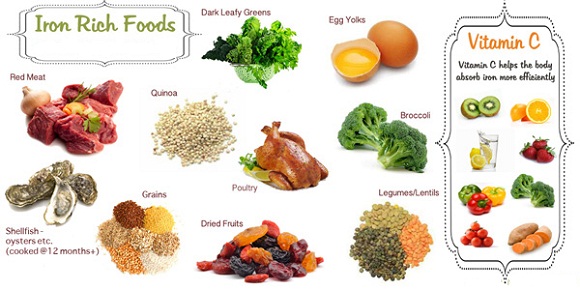
We so often warn vegetarians that they need to find a reliable source of vitamin B12. However, iron is a nutrient that is assumed to be adequate in the vegan diet, but due to its bioavailability issues, it is often not enough to prevent an iron deficiency, especially in women and children. Iron deficiency is a disorder that results from a depletion of iron stores in the body. It is characterized by weakness, fatigue, short attention span, poor appetite, increased susceptibility to infection, and irritability.

How does  iron function in the body?

  1. Oxygen enters the lungs.
  2. Oxygen attaches to iron in hemoglobin and myoglobin (found in red blood cells and muscle cells.
  3. Oxygenated hemoglobin transported in blood to body cells, drops off oxygen.
  4. Iron in hemoglobin then picks up carbon dioxide from cells and transports it to the lungs.
  5. Carbon dioxide is released from iron in hemoglobin
  6. Carbon dioxide is exhaled from the lungs.

This function of iron operates smoothly when the body’s supply of iron is sufficient. Unfortunately, that is often not the case. For example, a 3-ounce hamburger and a cup of asparagus both contain approximately 3 milligrams of iron, but 20 times more iron can be absorbed from the hamburger than from  the asparagus. See the following article for why  this occurs and what to do about it. Souce: Judith E. Brown, Nutrition Now, 7th edition

CLICK HERE.