Childhood obesity is rising again and seems to have few programs or solutions that address the issues. Many factors contribute to this epidemic such as genetics, unhealthy habits, lack of physical activity and environmental difficulties. Children are often unaware of the patterns or conditions that cause obesity, therefore, placing the responsibility on adults to lead them in the right direction. Obesity in childhood may lead to the same conditions and associated problems when these children reach adulthood.
Where are the programs????? Perhaps successful approaches should start with the food industry itself. A simple beginning is to check the “Added Sugar” on Nutrition Labels and limit sweetened soft drinks.
“The recommendation is that at most 10% of calories can come from added sugar. But 5% would obviously be better. That ‘s about five teaspoons a day. In terms of 2000 calories per day, that’s a small soda, or a teaspoon of sugar in each of five cups of coffee, or some ice cream or sweetened yogurt … We’re not saying “don’t eat sugar”. We’re saying “don’t eat a lot of sugar.” (Mark Bittman, David L. Katz, MD. How to Eat: All Your Food and Diet Questions Answered. p. 178-9.)
Jamie Vespa, M.S., R.D –Eating Well Magazine (Special Edition)
There is no one Mediterranean diet but many versions, and at the core of any of them is extra virgin olive oil – rich in vitamin E, carotenoids and polyphenols – all rich in antioxidants and anti-inflammatory properties. It can be used in cooking or in dips, spreads, and salad dressings.
FRESH FRUITS AND VEGETABLES
Look for the colors – green, red, purple, yellow, orange are pigments that have protective functions for the plants they come from. Moreover, they furnish the antioxidants we need to thwart oxidative stress or inflammation with phytonutrients needed for optimum health and disease prevention. Buy them fresh and seasonal when possible but canned or frozen are just as effective.
FRESH HERBS AND SPICES
Aromatic herbs and spices are staples in Mediterranean cooking. These reduce the need to use excess salt in addition to their antioxidant properties. You can count on parsley, basil, oregano, coriander, and bay leaves. Use fresh basil to make a pesto.
FRESH AND CANNED SEAFOOD
Omega -3 fish such as tuna, sardines and salmon are
enjoy ed fresh, canned or frozen. Clams and shrimp can used in pasta or grain dishes. Most can be served with lemon, olive oil and herbs. Most Med diet patterns suggest seafood twice per week.
WHOLE GRAINS
Wheat is the foundation; however, other grains can provide some variety. Farro is one of the traditional grains in dishes in Italy. Another classic grain is bulgur made from cracked wheat berries and used in pilafs. Coucous, pasta and barley are also found in regional cooking. On the ingredient labels. Look for “whole-grain” as the first ingredient.
LEGUMES (DRIED AND CANNED)
The chickpea is predominantly used for making hummus. Lentils are used commonly in soups and stews. Both are good sources of fiber.
NUTS AND SEEDS
Nuts are good for snacking thanks for their protein, fiber, and healthy fats. A common condiment is tahini made from ground sesame seeds. Use as salad dressing or over roasted vegetables.
OLIVES AND CAPERS
Kalamata olives are most popular in the region and often tossed with green salads, pastas or as tapenades. Olives of all kinds are rich in heart-healthy fats and phytochemicals as snacks. Capers are used to perk up flavors of pasta, baked fish and dressings.
CANNED TOMATOES
Tomatoes in any form (diced, whole, stewed, crushed, canned, fresh) are rich in a phytochemical called lycopene which may protect against some cancers. There is a plethora of marinara sauces in cans and jars as well as simply home-made.
GREEK YOGURT AND ARTISANAL CHEESES
The Med Diet favors full-fat dairy in small amounts. Yogurt is fermented and healthy for our microbiomes as gut-healthy probiotics. Cheese are made from milk and natural cultures in contrast to some U.S. processed cheeses. Feta cheese is used classically in salads. Harder cheeses like Pecorino Romano and Parmesan-Reggiano are often grated into pasta.
RED WINE
Wine is commonly served in moderation with food – Not as part of “happy hour” (a 5 oz. pour is the standard). Red wine contains antioxidant polyphenols and the flavonoid resveratrol may help to increase healthy HDL cholesterol and decrease unhealthy LDL cholesterol levels.
Lose weight and live longer on a vegetarian diet.? From the Harvard Medical School Health Guides
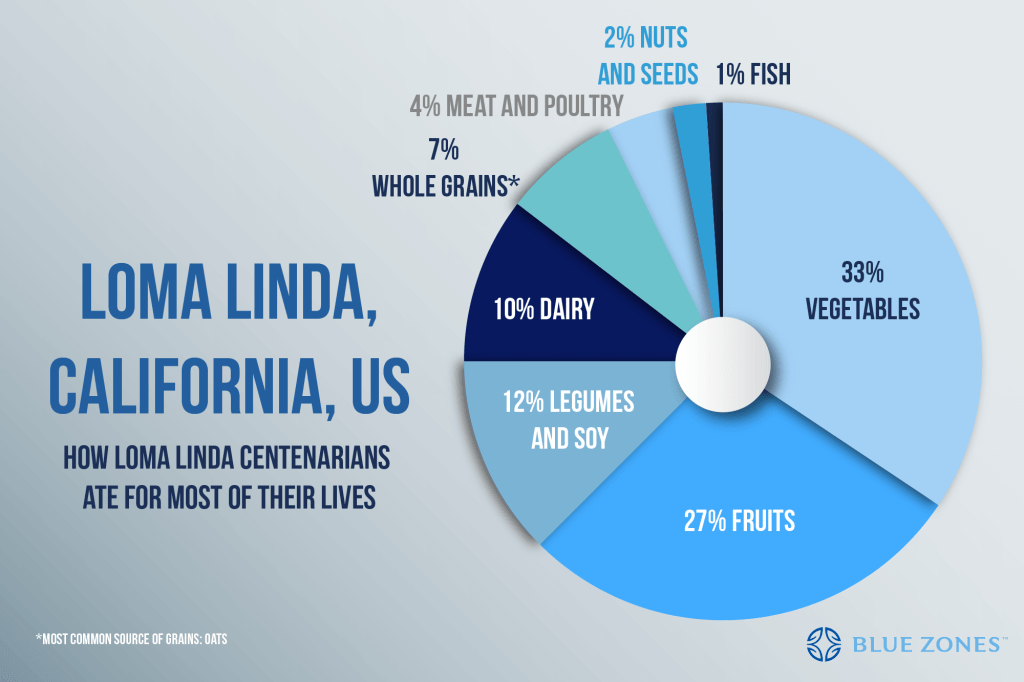
There is a lot of attention being paid to switching to a plant-based diet. There are many published articles on plant-based diets to achieve a lower body mass index, lower blood pressure, and reduced risks for heart disease, diabetes type 2, cancer, and longevity. Plenty of attention is being paid to the health benefits of those centenarians living in the Blue Zones, particularly ones that live with a vegan diet as well as those with a modified vegetarian approach.
The predominant American Blue Zone is represented by the Seventh – Day Adventists in Loma Linda, California. “The first Adventist Health Study (AHS-1) was funded by the National Institutes of Health followed 34,000 Adventists in California for 14 years. It was found that the Adventists who most strictly followed the religions’ teachings lived about 10 years longer than people who did not.
The practices most likely to yield that longevity were narrowed down to five, each adding about two years to life expectancy.” Dan Buettner, The Blue Zones Solution: Eating and Living Like the World’s Healthiest People. 2015
Eating a plant-based diet with only small amounts of dairy or fish
Not smoking
Maintaining a medium body weight
Eating a handful of nuts four to five times a week
Doing regular physical activity
DietOptions:
A flexitarian diet – meat is limited as a condiment and not considered the main attraction. Use vegetables, appetizers instead.
Semi vegetarian diet (no red meat)
Pescetarian – avoid meat and poultry but eat fish and seafood.
Lacto -ovo -vegetarian – skip all meat, fish, and poultry but include dairy and eggs in your diet.
If you’re trying to lose weight -go heavy on fruits, vegetables, and whole grains but limit foods high in saturated fats (ice cream, whole milk, and cheese.)
An important aspect of losing weight is often not what you eat – but how much you eat to keep daily calories in check.
“Our meals and snacks are taking on gargantuan proportions. The food industry decided they had to make portions larger to stay competitive and people got used to larger sizes very quickly. Today, normal sizes seem skimpy,” says Marion Nestle,PhD, MPH, Professor of Nutrition and Food Studies at New York University.
When eating out, the transition to a plant-based diet is easier than thought. Fill your plate with vegetables – cooked, raw, or in a salad. Check out the sides that are offered. Then gradually introduce all vegetarian meals once or twice a week and if you like, increase it until you are as “vegan” as you want to be.
“The DASH Diet (Dietary Approaches to Stop Hypertension) has generally come in right near the top in U.S. News and World Report’s annual best diet rankings.” Mark Bittman, David L.Katz, M.D. How to Eat: All Your Food and Diet Questions Answered. 2020.
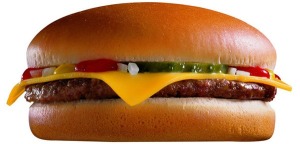
The 1950’s brought a renewed hope for the country after two decades of Depression and War. However, food historians deplore the state of the cuisine during this period – it mainly consisted of processed foods which many blame for this anti-gastronomic desert. In addition, the rise of the fast food industry, i.e. hamburger chains that sprouted up along side the newly build national highway system did not offer any better fare. Freeing Mom from the kitchen seemed to be the dominant theme as appliances and prepared foods became the ‘norm”.
TV Dinners
After WWII, America’s economy boomed, women entered the workforce as never before and food got a little strange. Housewives spent less time in the kitchen, so food companies came to the rescue with a buffet of processed foods. Foods were purchased in a can, package or pouch. Soups were available as liquids or in dry form. Tang landed on supermarket shelves and frozen dinners laid on trays in front of TV sets. TV dinners were introduced in 1953 by Swanson and with a flick of a wrist you could turn back the foil to display turkey in gravy, dressing, sweet potatoes and peas ready in about 30 minutes – all with no dishes to wash.
Better Living Through Chemistry
“Better Living through Chemistry” was the slogan of the times along with “I like Ike” referring to the popular Dwight D. Eisenhower, the 5-star general from WWII winning the U.S presidency from 1953 to 1961. This change in processing came from the demand of the Army during WWII to provide needed ready-to-eat meals. The food industry responded by ramping up new technologies in canning and freeze-drying to feed the troops. The marketing of these foods presented a challenge, however. At first, many of them were less than palatable, so food companies hired home economists to develop fancy recipes and flooded magazines, newspapers and TV with ads to broadcast their virtues. Actually the first cake mix was available in 1931, but was met with disdain due to the use of dehydrated eggs, e.g. Women later would respond more favorably if they could crack their own eggs into the batter so they would feel like they were doing something positive in the kitchen.
June Cleaver
People rushed to buy appliances, houses, cars, dishwashers, washing machines, dryers and backyard barbecue grills and new home freezers. They also bought television sets in record numbers and watched shows that represented their new idealized lives like Ozzie and Harriet and Leave It to Beaver. Beaver’s mother, June Cleaver was depicted as a housewife freed from household chores and often was serene and perfectly dressed with pearls and high heels pushing a vacuum cleaner and putting meals on the family table, all before solving the family problems.
Fast Food Nation
The birth rate soared and created what is known as the Baby Boomer Generation. Fifty million babies were born from 1945 to 1960. Food marketing shifted to kids with Tony the Tiger and fish sticks leading the campaign. Fast food had its beginnings strengthened in 1955 when Ray Kroc bought a hamburger stand from the McDonald’s brothers in San Bernadino, California. Disneyland opened in 1955 and was so popular they ran out of food on the first day.
The Seven Countries Study
In 1958, the American scientist, Ancel Keys started a study called the Seven Countries Study, which attempted to establish the association between diet and cardiovascular disease in different countries. The study results indicated that in the countries where fat consumption was the highest also had the most heart disease. This suggested the idea that dietary fat caused heart disease. He initially studied 22 countries, but reported on only seven: Finland, Greece, Italy, Japan, The Netherlands, United States, and Yugoslavia.
The problem was that he left out:
Countries where people eat a lot of fat but have little heart disease, such as Holland and Norway and France.
Countries where fat consumption is low but the rate of heart disease is high, such as Chile.
Basically, he only used data from the countries that supported his theory. This flawed observational study gained massive media attention and had a major influence on the dietary guidelines of the next few decades, i.e. cut the fat out of our diets.
The First Artificial Sweetener
In the diet world, Saccharin was manufactured in granules and became a popular sugar substitute for dieters. It was first produced in 1878 by a chemist at Johns Hopkins University, but became popular after sugar shortages in WWI and WWII. In the United States, saccharin is often found in restaurants in pink packets as “Sweet’n Low”. It was banned later but it remains on the market today. The basis for the proposed ban was a study that documented an increase in cancer in rats being fed saccharin. The “Delaney clause” of the Food Additive Amendments to the Federal Food, Drug, and Cosmetic Act states that no substance can be deemed safe if it causes cancer in humans or animals. In suspending the proposed saccharin ban, Congress ordered that products containing the popular sweetener must carry a warning about its potential to cause cancer. The FDA formally lifted its proposal to ban the sweetener in 1991 based on new studies, and the requirement for a label warning was eliminated by the Saccharin Notice Repeal Act in 1996.
TIMELINE:
1951 I Love Lucy debuts on CBS.
1952 The Lipton food company rolls out its dehydrated onion soup that will earn it fame as a base for onion soup mix: 2 envelopes of mix plus 1 cup of sour cream. Lipton eventually prints the recipe, “California Dip” on the package.
1953 Eggo Frozen Waffles are introduced.
1954 Employee Gerry Thomas from the C.A. Swanson Co, has an idea (although fellow workers nearly laughed him out of the Omaha plant): package the left-over turkey, along with some dressing, gravy, cornbread, peas and sweet potatoes into a partitioned metal tray, sell it frozen, and consumers could heat it up for dinner. His name for the leftover meal: TV Dinner.
1954 The first Burger King opens in Miami. A burger is 18 cents, as is a milkshake. The Whopper is introduced in 1957 and sells for 37 cents.
1955 Milkshake-machine salesman, Roy Kroc tries to persuade Dick and Mac McDonald (owner of the original McDonalds in California) to franchise their concept. They aren’t interested but tell Kroc to go ahead and try his hand. Kroc opens his first restaurant in Des Plains, ILL., and eventually buys out the McDonalds.
1956 Jif Peanut Butter is introduced.
1956 More than 80 percent of U.S. households have refrigerators. By contrast, only 8 percent of British households have refrigerators.
1957 Better Homes and Gardens prints its first microwave-cooking article.
1957 Margarine sales take the lead over butter.
1958 Eighteen- year-old Frank Carney sees a story in the Saturday Evening Post about the pizza fad among teenagers and college students. With $600 borrowed from his mother, he and his fellow Wichita State classmate, opens the first Pizza Hut in Wichita, KS.
As many as 95% of Americans are not getting enough fiber. Even though fiber is super important for gut health, new research suggests that without adequate fiber, you may be increasing your risk for dementia. According to the author of a recent study, “one possibiity is that soluble fiber regulates the composition of gut bacteria (microbiome). This composition may reflect neuroinflammation, which plays a role in the onset of dementia.” Soluble fiber is found in foods such as oats, legumes, apples, carrots, and citrus fruits. Unless you like statistics, skip them.
Greater Cruciferous Vegetable Intake Associated with less Aortic Calcification
To Define:
“Aortic calcification, also known as aortic valve calcification (or sclerosis) is a condition where large calcium deposits get accumulated in the aorta of the heart. These calcium deposits can cause the opening of the aortic valve to become narrow and reduce the flow of blood to the heart resulting in chest pain and heart attack.”
“Aorta – the main artery of the body, supplying oxygenated blood to the circulatory system. In humans. “
A study published in the British Journal of Nutrition showed an association between an increased intake of Brussels sprouts, cabbage, cauliflower, and other cruciferous vegetables and less extensive abdominal aortic calcification (AAC defined above) in older women. The study population included 684 women with a mean age of 75 who previously had enrolled in the Calcium Intake Fracture Outcome Study (1998) conducted at the University of Western Australia. Diet intake questionnaires were given to participants and calcification detected as extensive or not extensive was determined by imaging techniques.
A correlation was observed between greater cruciferous vegetable intake and a reduction of AAC. Women whose intake of the vegetables was more than 44.6 grams a day (equivalent of 1/4 cup of steamed broccoli or 1/2 cup of raw cabbage had a 46% lowered adjusted risk of extensive AAC, compared to those whose intake was less than 15 grams a day. Total vegetable intake, including other types of vegetables, was not related with risk.
Interestingly, cruciferous vegetables have had positive results with lessening disease risk not only in heart calcification but in cancer prevention. Vegetables in this family not only include broccoli, cabbage and cauliflower, but bok choy, kale, kolrabi, and Swiss chard. These vegetables are excellent sources of a family of anticancer phytochemicals called isothocynates that fight cancer by neutralizing carcinogens.
Broccoli also contains high levels of a phytochemical called sulforaphane. Sulforaphane increases the activation of enzymes known as phase-2 enzymes, which help fight carcinogens. According to the Department of Urology at Stanford University published in Cancer Epidemiology Biomarkers and Prevention, sulforaphane is the most potent inducer of phase-2 enzymes of any phytochemical known to date.
SOURCE: Life Extension, February, 2021
Bowden, Jonny, Ph.D., C.N.S. The 150 Healthiest Foods on Earth, 2007










 FOOD, FACTS and FADS